Medemer:
Principled Hybridity Between Forced National Synergy and Regional Maximization in Ethiopia

Ethiopia is not a polity that can be governed by simple majorities or tidy constitutional formulas. It is a mosaic of identities, ethnic, linguistic, religious, and historical, forged through centuries of both cooperation and conflict. For decades, Ethiopian governance has swung between two competing logics: forced national synergy (aggressive centralization in the name of unity) and regional maximization (radical devolution in the name of autonomy). Neither has delivered enduring stability.
Medemer, which stands for synergy, and interdependence, offers a third path. Medemer is not a temporary political slogan, it is a principled hybridity: an institutional and ethical framework that refuses the false choice between unity and diversity. Instead, it seeks to minimize the characteristic failures of both extremes while maximizing their strengths. This piece outlines why hybridity is necessary, what Medemer means in practice, and the conditions under which it can succeed.
The Two Imperfect Logics
Forced National Synergy
This approach treats the Ethiopian state as a singular, indivisible entity that must be engineered from the center. Whether through imperial assimilation policies, the Derg’s socialist central planning, or later attempts at top-down integration, the logic is the same: strong coordination requires homogeneity or at least subordination of peripheral identities to a national core.
Strengths: Centralized systems excel at large-scale coordination, building national infrastructure, maintaining security, and executing macroeconomic policy. They can mobilize resources for projects that no single region could undertake alone.
Weaknesses: They are almost inevitably experienced by peripheral groups as cultural erasure or domination. Legitimacy collapses when citizens feel the state is “someone else’s.” Resistance becomes inevitable, and the center ends up spending more energy suppressing dissent than delivering services. Local knowledge, initiative, and accountability are stifled.
Regional Maximization
The post-1991 ethnic-federal model inverted the equation. It prioritized self-rule for ethno-linguistic groups, granting regions extensive autonomy over language, education, security, and resources. The goal was representation and the protection of identity.
Strengths: This model dramatically expanded political voice for previously marginalized communities and allowed culturally grounded governance in diverse territories.
Weaknesses: It fragmented the national political economy. Regions became rival power centers engaged in competitive nationalism. Zero-sum bargaining over federal resources, land, and investment became routine. Collective-action problems, national security, cross-regional infrastructure, macroeconomic stability, proved chronically difficult to solve. The result was weak state capacity at the center precisely when citizens still expected the state to deliver national public goods.
Both models, in their purest forms, are “second-best” failures. In deeply divided societies, first-best solutions (perfect unity or perfect autonomy) are illusory. The real question is how to design institutions that live with the inescapable trade-offs.
Why Hybridity Is Necessary
Fragmented societies face permanent tensions between efficiency and legitimacy, coordination and autonomy. Pure centralization buys coordination at the price of legitimacy. Pure devolution buys legitimacy at the price of coordination. Sustainable governance therefore requires deliberate institutional synthesis, an architecture that distributes power while enforcing interdependence.
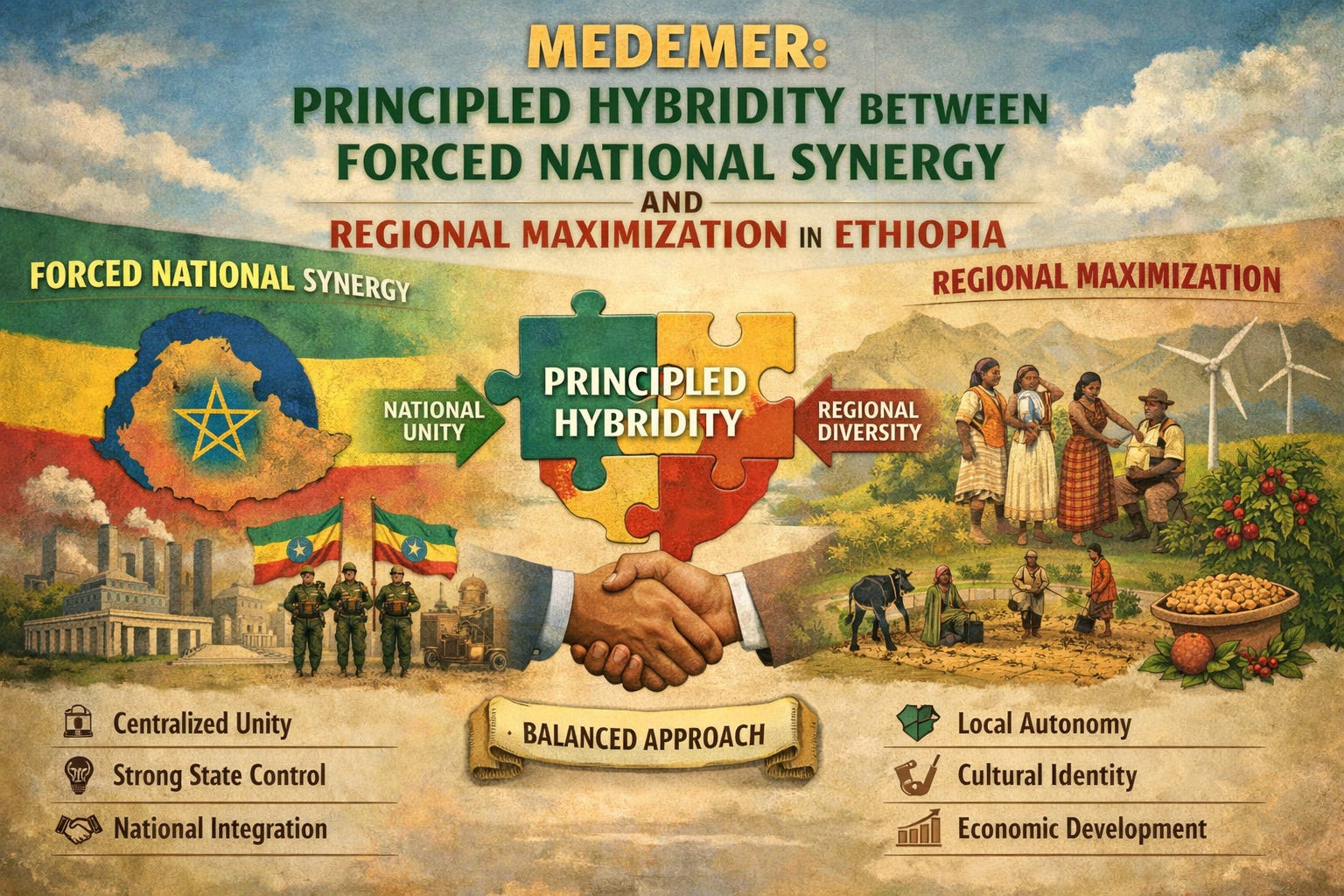
This is not theoretical idealism. Comparative evidence from India’s “cooperative federalism,” Canada’s asymmetric federalism, and even the European Union’s multilevel governance shows that hybrid systems can manage deep diversity better than binary models. Ethiopia’s context, where identity cleavages are both real and politically mobilized, makes hybridity not merely preferable but necessary for survival.
Medemer as Principled Hybridity
Medemer is literally means “addition” in Amharic or “coming together.” In its deeper philosophical sense, it denotes synergy, mutual benefit, and interdependence. Medemer is not a mere rhetorical unity that papers over differences or a loose confederation that abandons national cohesion.
Instead, Medemer is a normative principle (cooperation over competition), a governance philosophy (shared sovereignty), and a political ethic (mutual recognition and reciprocity). It treats regions and the federal center as co-dependent partners rather than rivals or subordinates.
Core Principles of Medemer
1. Mutual Recognition: Identities are acknowledged as legitimate sources of meaning and belonging, but not essentialized into permanent political castes. Recognition is the starting point for negotiation, not the end of politics.
2. Reciprocal Interdependence: Regions need the center for scale, security, and market access. The center needs regions for legitimacy, local implementation capacity, and policy innovation. This mutual interdependence must be institutionalized rather than assumed.
3. Layered Sovereignty: Authority is neither wholly centralized nor wholly devolved. It is distributed across levels and functions, with clear mechanisms for coordination where national interests are at stake.
4. Non-Zero-Sum Politics: Political competition is reframed from winner-takes-all ethnic bargaining to coalitional problem-solving. Gains for one region need not be losses for another when institutions reward positive-sum outcomes.
5. Deliberative Integration: Unity is negotiated continuously through dialogue, not imposed by decree. Constitutional review, intergovernmental councils, and public forums become routine venues for renegotiating the social contract.
Institutional Implications
Reimagining Federalism:
Move from pure and rigid type of federalism toward a hybrid model that combines functional federalism (cooperation on infrastructure, water, energy, and trade) with cooperative mechanisms. Strengthen the House of the Federation and create robust intergovernmental forums with binding arbitration powers for disputes.
Shared National Projects: Infrastructure corridors, national security architecture, and macroeconomic policy should be framed as joint ventures with explicit regional co-ownership. Revenue-sharing formulas, joint implementation bodies, and transparent performance metrics can reduce perceptions of central imposition.
Conflict Management: Institutionalize permanent dialogue platforms at national and regional levels. Medemer offers a conflict-transformation lens: disputes are not zero-sum battles over resources or identity but opportunities to renegotiate interdependence.
Political Culture Shift: Political parties and elites must move from ethnic mobilization to cross-cutting coalitions. Medemer rewards leaders who demonstrate restraint and inclusion rather than maximalist claims.
Risks and Critiques
Medemer is not immune to criticism. Skeptics rightly note that the concept can be vague, allowing it to be stretched in contradictory directions. It risks being co-opted as ideological cover for recentralization. Without clear institutional guardrails, it could remain aspirational rhetoric.
The response is straightforward: Medemer must be institutionalized, not merely invoked. Credible safeguards, constitutional protections for regional autonomy, independent courts, transparent fiscal rules, and veto powers on core identity issues, are non-negotiable. Hybridity works only when power is both shared and checked.
Conditions for Success
Medemer cannot succeed through philosophy alone. It requires:
- Political leadership willing to exercise restraint and practice inclusion rather than domination or fragmentation.
- Strong, independent institutions for intergovernmental negotiation and dispute resolution.
- Deliberate trust-building mechanisms across regions and communities.
- Civic narratives that honestly balance unity and diversity, neither romanticizing a mythical past nor weaponizing historical grievances.
From Trade-Off to Synthesis
Ethiopia’s fundamental challenge is not choosing between unity and autonomy. It is learning to live productively with both. Forced national synergy and regional maximization each generate predictable pathologies. Medemer does not eliminate trade-offs; it manages them more intelligently by turning interdependence into a design feature rather than a bug.
The future of Ethiopian statehood depends on whether we can translate Medemer from an attractive philosophical idea into a lived institutional reality. That work is hard, incremental, and often unglamorous. But it is the only path that offers a genuine chance to escape the cycle of oscillation between over-centralization and fragmentation.
The question is not whether Ethiopia can be perfectly unified or perfectly decentralized. The question is whether we can build institutions wise enough to add our differences rather than subtract them.
Ethiopia has to pursue a political strategy based on the shared cultural and historical values of its people. Our political road map and path way has to be redesigned well. I prefer that Ethiopian anthropologists and sociologists come together and provide a proper scientific and indigenous political philosophy to Ethiopia. Ofcourse 'Medemer' can be spice to what we think and research (cook).